
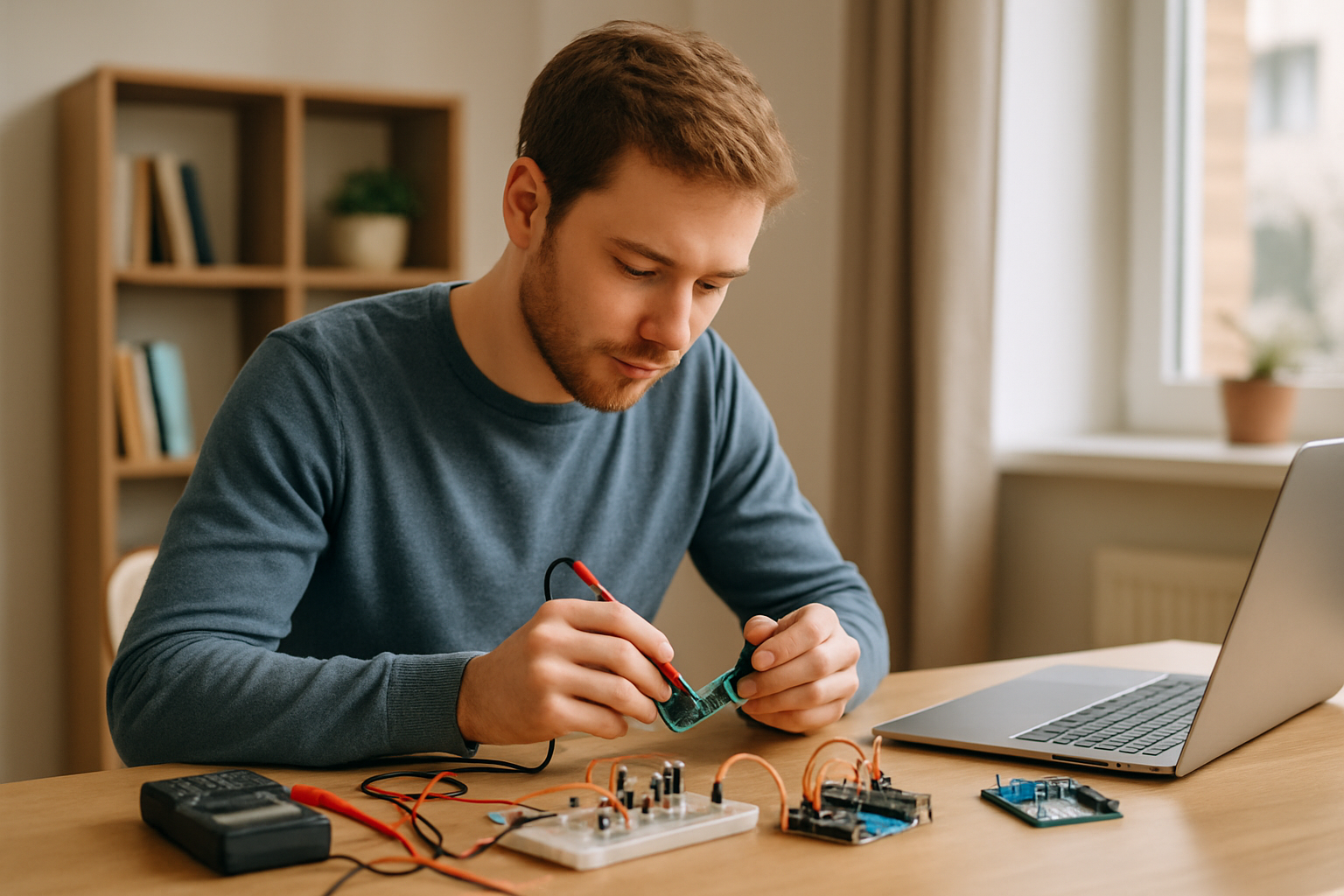
How to Learn Electronics at Home: Master DIY Skills Fast
Are you interested in mastering the art of electronics without stepping outside your home? With the rise of online resources and DIY kits, learning electronics at home has never been more accessible. In this guide, we will share expert insights and practical tips to help you navigate the world of electronics, from understanding basic components to building your first circuit. Whether you’re a complete beginner or looking to enhance your skills, you’ll find valuable information here. Get ready to embark on a rewarding journey that can lead to exciting projects and innovations right in your own workspace.
Understanding Basic Electronics Concepts
Before diving into practical projects, it’s crucial to grasp the foundational concepts of electronics. Start with the key principles such as voltage, current, and resistance, which form the basis of electrical circuits. Familiarize yourself with Ohm’s Law, which defines the relationship between these elements and will be your guiding principle for calculations. Understanding these basics will provide a solid platform for more advanced topics like circuit analysis and design.
Voltage, Current, and Resistance
Voltage is the electrical potential difference, current is the flow of electric charge, and resistance opposes that flow. Learning how these three interact through Ohm’s Law (V=IR) is essential. Experiment with simple circuits using batteries and resistors to see these concepts in action.
Components of an Electrical Circuit
Familiarize yourself with fundamental components such as resistors, capacitors, diodes, and transistors. Understand their functions and how they interact within a circuit. Building simple circuits using breadboards can help solidify this knowledge practically.
Basic Circuit Theory
Explore basic circuit theory concepts, including series and parallel circuits. This knowledge will help you understand how to calculate total resistance, current flow, and voltage drops. Practicing with circuit simulations can enhance your comprehension.
Key Points:
- Foundational concepts are essential for effective learning in electronics.
- Practical application through experiments reinforces theoretical knowledge.
💡 Start with online tutorials or courses that cover basic electronics concepts; structured learning can provide a comprehensive understanding.
💡 Utilize free resources like educational videos and articles to reinforce your knowledge of core principles.
💡 Join online forums or communities to discuss concepts and troubleshoot problems with fellow learners.
Setting Up Your Home Electronics Lab
Creating a dedicated space for electronics learning can greatly enhance your productivity and focus. Start by finding a well-lit area where you can comfortably work on projects. Gather essential tools such as a multimeter, soldering iron, and a breadboard. These tools will enable you to conduct experiments and build circuits effectively. Organizing your workspace will help you stay focused and make the learning process smoother.
Essential Tools and Equipment
Invest in basic tools like a multimeter for measuring voltage, current, and resistance, as well as a soldering iron for assembling circuits. Additional tools like wire strippers and pliers will also be beneficial. Understanding how to use these tools is just as important as having them.
Safety Practices in Electronics
Safety should always be a priority when working with electronics. Familiarize yourself with basic safety practices, such as ensuring your workspace is dry and free from clutter. Always disconnect power sources before making adjustments to circuits to avoid electric shock.
Organizing Your Workspace
A clean and organized workspace can significantly boost your efficiency. Use storage bins for components, label your tools, and keep your workspace tidy. This organization will help you locate materials quickly and maintain focus during your projects.
Key Points:
- A well-equipped and organized lab enhances the learning experience.
- Prioritizing safety is crucial when working with electrical components.
💡 Make a checklist of essential tools before setting up your lab to ensure you have everything you need.
💡 Implement a ‘clean as you go’ policy to keep your workspace organized and safe.
💡 Regularly review safety protocols to ensure you are aware of the best practices while working with electronic components.
Building a Strong Foundation in Electronics
To effectively learn electronics at home, begin by establishing a solid understanding of fundamental concepts. Start with basic principles, such as voltage, current, resistance, and Ohm’s Law, which are crucial for all electronic applications. Use online resources, textbooks, and tutorials to grasp these concepts, as they lay the groundwork for more advanced topics. Additionally, familiarize yourself with electronic components like resistors, capacitors, and transistors, and understand their functions within a circuit. Hands-on practice is essential; consider assembling simple circuits using breadboards to reinforce theoretical knowledge.
Understanding Basic Concepts
Begin with the basic terminology and principles of electronics. Study Ohm’s Law, Kirchhoff’s laws, and the function of various components. Online courses, videos, and textbooks can provide structured learning paths. Create flashcards for key terms to enhance retention.
Practical Application with Simple Circuits
After grasping the basics, practice constructing simple circuits. Use a breadboard to assemble circuits without soldering, allowing for experimentation. Start with LED circuits and gradually progress to more complex setups, ensuring you apply theoretical knowledge practically.
Key Points:
- A solid grasp of basic concepts is essential for advanced learning.
- Hands-on practice solidifies theoretical knowledge.
💡 Engage with online communities for troubleshooting and advice.
💡 Document your projects and experiments to track progress and learning.
💡 Experiment with variations in circuit designs to deepen understanding.
Advancing Your Skills Through Projects and Resources
Once you have a solid foundation, tackle more complex projects to enhance your skills. Choose projects that challenge you, such as building a radio transmitter or a simple robot. Utilize online platforms, tutorials, and forums to find project ideas and guidance. Additionally, invest time in learning about microcontrollers and programming, as these are integral to modern electronics. Resources like open-source platforms and simulation software can provide valuable practice without needing extensive physical components.
Tackling Intermediate Projects
Select projects that push your limits, such as building a weather station or a home automation system. Break each project into smaller tasks, allowing you to focus on one component at a time. This method not only builds your skills but also gives you a sense of achievement.
Exploring Microcontrollers and Programming
Learn to program microcontrollers, which are pivotal in electronics today. Start with basic coding tutorials and gradually move towards integrating hardware with software. Understanding programming will open doors to more complex projects and innovations.
Key Points:
- Engaging in projects accelerates practical learning.
- Programming skills greatly enhance your capabilities in electronics.
💡 Join local maker spaces or online groups for collaborative learning.
💡 Regularly challenge yourself with new projects to avoid stagnation.
💡 Utilize simulation software to test circuits before building them.
EXPERT TIPS Pro Advice
Start with online courses for structured learning.
Online courses provide a comprehensive framework to learn systematically, which is especially useful for beginners who may feel overwhelmed by information.
Keep a dedicated electronics journal.
Documenting your experiments and discoveries helps reinforce learning and provides a reference for future projects.
Use simulation tools for circuit design.
Simulation tools allow you to experiment without physical components, reducing costs and enabling rapid iteration of ideas.
Collaborate with others on projects.
Working with peers exposes you to diverse ideas and problem-solving techniques, enriching your learning experience.
Set specific learning goals.
Defining clear, achievable goals helps maintain motivation and provides a roadmap for your learning journey.
Frequently Asked Questions
Conclusion
Learning electronics at home is both accessible and rewarding. Begin with the fundamentals, leverage online resources, and engage in hands-on projects. Building a strong foundation and seeking community support can significantly enhance your skills and confidence as you progress.
🎯 Key Takeaways:
- Start with basic concepts like voltage and current.
- Utilize online tutorials and courses for structured learning.
- Hands-on practice is crucial for skill development.
- Essential tools include a multimeter and breadboard.
- Break down complex topics into smaller parts.
- Joining a community can provide valuable support.
Expert Advice: Stay curious and patient as you learn. Embrace mistakes as learning opportunities, and don’t hesitate to ask questions. The more you practice, the more proficient you will become in electronics.
Begin your electronics journey today by exploring free online resources and starting simple projects to build your skills.
Leave a Reply